
What if your landscape could do more than look beautiful? What if it could restore soil, capture rainwater, support biodiversity, produce food, and increase the long-term value of your property?
That is the opportunity behind sustainable landscape design. Rather than treating the land as a blank canvas to be shaped and maintained, sustainable landscaping considers how water, soil, plants, wildlife, buildings, and people interact as one living system.
At 5th World, we believe the future of property design lies in moving beyond sustainability toward regeneration. The goal is not simply to reduce environmental harm, but to create landscapes that actively improve the ecological health, functionality, and resilience of a place over time.
Whether you own rural acreage, are developing a residential property, manage an agricultural operation, or are planning a larger land-based project, the decisions you make today can influence your property’s ecological performance and economic potential for decades.
In this guide, we explore what sustainable landscape design means, how it works in practice, which principles matter most, and how to approach your property as an integrated, regenerative system.
What Is Sustainable Landscape Design?
Sustainable landscape design is the process of planning, developing, and managing outdoor spaces to minimize environmental impacts while supporting ecological health, resource efficiency, and long-term functionality.
It considers more than plant selection or the use of drought-tolerant species. Effective sustainable landscaping examines the relationships between the land’s natural features, built infrastructure, water movement, soil conditions, vegetation, and human activities.
A thoughtfully designed landscape can help:
- Reduce potable water consumption through rainwater harvesting, soil improvement, and appropriate plant selection
- Improve soil health by increasing organic matter, protecting the soil surface, and minimizing unnecessary disturbance
- Support biodiversity through native plants, habitat corridors, and diverse vegetation
- Reduce erosion and manage stormwater by slowing, spreading, and infiltrating rainfall where appropriate
- Lower long-term maintenance requirements through site-appropriate planting and ecological management
- Create opportunities for food production, recreation, education, and other productive land uses
- Strengthen a property’s resilience to drought, heavy rainfall, and changing environmental conditions
The precise benefits depend on the site’s climate, soil, topography, existing ecology, and management. There is no universal landscape plan that works everywhere.
The most effective designs begin by understanding the place itself.
Sustainable vs. Regenerative Landscape Design
Sustainable and regenerative landscape design share many principles, but they differ in their underlying ambition.
Sustainable design generally seeks to reduce resource consumption, minimize environmental damage, and maintain ecological function over time. Regenerative design goes further by asking how a landscape can help restore the natural systems on which it depends.
For example, a conventional sustainable landscape might reduce irrigation by replacing thirsty lawn with drought-tolerant plants. A regenerative approach might also improve soil structure, restore locally appropriate habitat, direct rainwater into suitable infiltration areas, and create conditions for a more diverse and self-supporting ecosystem.
| Approach | Primary objective | Example |
| Conventional landscaping | Appearance and usability | Installing a lawn, ornamental beds, and irrigation |
| Sustainable landscaping | Reduce environmental impact | Choosing climate-appropriate plants and improving irrigation efficiency |
| Regenerative landscaping | Restore and strengthen living systems | Combining soil restoration, water management, habitat creation, and productive land use |
These approaches are not mutually exclusive. A well-designed regenerative landscape can be beautiful, functional, and resource-efficient.
The distinction is that regeneration treats ecological improvement as a core design objective rather than an optional benefit.
The Five Core Principles of Sustainable Landscaping
1. Design Around Water, Not Against It
Water is one of the most important forces shaping a landscape. Rainfall patterns, slope, soil permeability, drainage, groundwater, and vegetation determine where water travels, where it accumulates, and how long it remains available to plants.
Conventional development often attempts to move water away from buildings and paved surfaces as quickly as possible. While appropriate drainage around structures is essential, rapidly exporting all available rainwater can increase downstream runoff and reduce opportunities for local infiltration.
Sustainable landscape design takes a more considered approach.
Start by understanding how water moves across your property. Identify natural drainage routes, low-lying areas, seasonal wet spots, erosion channels, and places where runoff concentrates.
Then evaluate opportunities to:
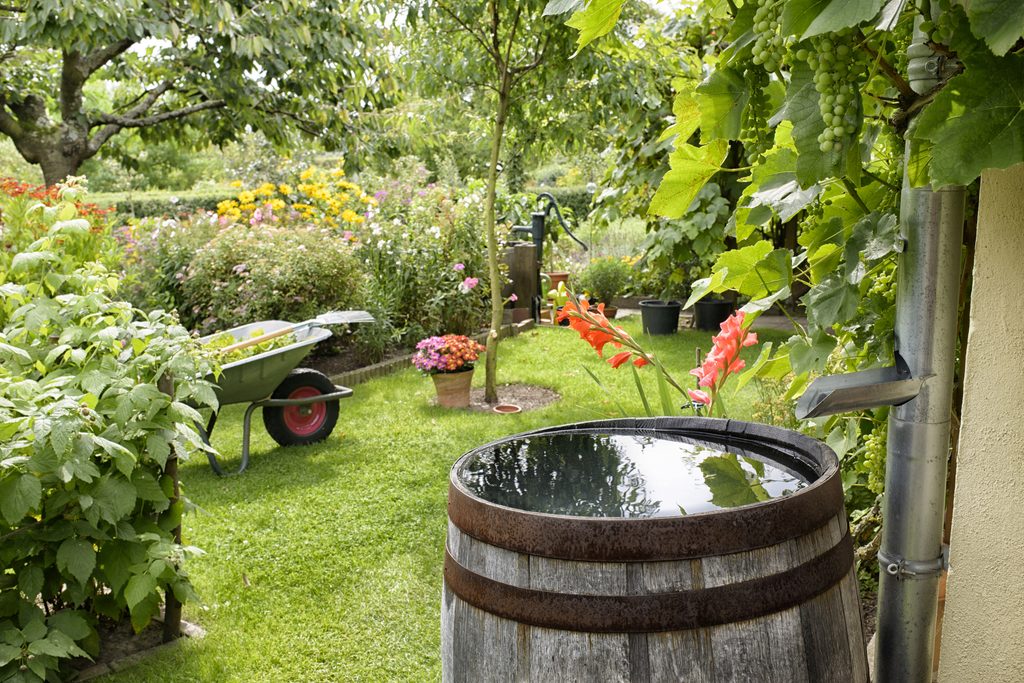
- Direct roof runoff into rainwater storage or suitable planted areas
- Use rain gardens to capture and filter runoff where soil and groundwater conditions permit
- Establish vegetated swales to slow and guide water
- Improve soil structure and ground cover to support infiltration
- Select plants suited to local rainfall and seasonal moisture conditions
- Reduce unnecessary irrigation through appropriate planting and mulching
On a rural property in British Columbia, for example, a landscape plan might consider winter rainfall, summer drought, wildfire exposure, slope stability, and seasonal stream flows. The appropriate response will differ between a dry interior site and a wetter coastal property.
Water-management features must be designed for local conditions. Infiltration near foundations, unstable slopes, contaminated soils, or sensitive groundwater areas may be inappropriate without professional assessment.
The objective is not to retain every drop of water everywhere. It is to manage water safely and intelligently, using the landscape to support the property’s ecological and practical needs.
5th World’s Land Inspection helps you understand how water moves—and can be managed—on your property. Learn more.
2. Build Healthy Soil Before Adding More Plants
Healthy soil is the foundation of a resilient landscape.
Soil stores and cycles nutrients, supports plant roots, regulates water movement, and provides habitat for an enormous diversity of organisms. Yet construction, compaction, erosion, and repeated disturbance can compromise these functions long before the first plant is installed.
Adding more vegetation without addressing underlying soil problems can result in expensive planting failures and ongoing maintenance.
A better approach begins with assessment.
Understand the existing conditions. Examine soil texture, drainage, compaction, organic matter, and pH where relevant. Laboratory testing can help identify nutrient deficiencies or contamination concerns.
Protect the soil structure. Limit unnecessary grading, heavy equipment traffic, and disturbance around established trees. Where construction is planned, define protection zones before work begins.
Increase organic inputs appropriately. Compost, leaf litter, woody mulch, and plant residues can help build organic matter when selected and applied according to site conditions.
Keep the ground covered. Living ground cover, perennial planting, and suitable mulch reduce exposure to rainfall impact, wind, and temperature extremes.
Choose plants that fit the soil. Selecting species adapted to existing conditions often reduces the need for fertilizers, irrigation, and intensive soil amendments.
Healthy soil does not develop overnight. Its improvement is a long-term process that requires monitoring and management.
For property owners, this matters because soil restoration can support many objectives simultaneously: More resilient planting, improved water handling, reduced erosion, and healthier productive areas.
5th World’s Land Inspection helps you understand how water moves—and can be managed—on your property. Learn more.
3. Design for Biodiversity and Ecological Function
A landscape can contain hundreds of plants and still provide limited habitat if those plants offer little ecological value.
Biodiversity-friendly sustainable landscaping considers the relationships between plants, pollinators, birds, soil organisms, and other wildlife.
The first step is to understand what already exists. Mature trees, wetlands, hedgerows, native plant communities, and natural drainage corridors may provide ecological value that would take years to recreate.
Protecting these features can be more effective than removing them and attempting to rebuild habitat later.
Where restoration or new planting is appropriate, consider:
- Native and locally appropriate plant species that support regional wildlife
- A diversity of flowering periods to provide resources across the growing season
- Multiple vegetation layers, including trees, shrubs, perennials, and ground cover
- Connected habitat areas rather than isolated ornamental beds
- Reduced pesticide use and careful management of invasive species
- Retention of suitable deadwood, leaf litter, and other habitat features where safe
Plant selection should reflect the actual ecological context. A species native to one part of British Columbia may be unsuitable for another, and not every native plant is appropriate for every soil or moisture condition.
The goal is to create a landscape that supports ecological relationships, not simply one that contains a particular list of plants.
5th World’s Land Inspection helps you understand which plants exist and which plants can thrive on your property. This helps inform garden and food forest design. Learn more.
4. Reduce Inputs Through Smarter Design
A landscape that depends on frequent irrigation, fertilizer, pesticide applications, mowing, and replacement planting may be expensive to maintain and vulnerable to disruptions.
Sustainable landscaping reduces unnecessary inputs by designing around the site’s natural capacities.
This can include grouping plants according to their water requirements, using ground covers to reduce exposed soil, selecting species suited to local conditions, and choosing appropriate planting densities.
Maintenance requirements should also be considered during the design phase.
For example, a property owner who wants an attractive landscape but has limited time for upkeep should not receive a plan that depends on intensive pruning, frequent mowing, or delicate plants that require constant intervention.
Similarly, a rural property intended for food production may benefit from a landscape that combines productive planting areas, efficient access routes, composting infrastructure, and practical water distribution.
There is an important distinction between low-maintenance and no-maintenance landscaping. All landscapes change over time. Newly planted areas require establishment care, and ecological restoration may involve several years of active management.
Good design reduces avoidable work while making necessary management more effective.
5th World’s Concept Design helps you understand how your food, water, and energy systems can be designed together efficiently. Learn more.
5. Integrate the Landscape With the Property as a Whole
The greatest opportunities often emerge when landscape decisions are coordinated with buildings, infrastructure, agriculture, and long-term land use.
For example, the location of a driveway affects runoff and access. Building placement influences solar exposure, wind, views, and the amount of land disturbed. Water storage may support irrigation, while productive planting areas may influence how people move through a property.
Considering each decision independently can lead to missed opportunities or costly conflicts.
An integrated approach asks how the elements of a property can support one another.
A residential development might coordinate building orientation, shade trees, permeable surfaces, and stormwater management. A rural estate might combine habitat restoration, orchard planting, food production, and carefully planned circulation. An agricultural property might connect erosion control, water infrastructure, soil health, and production goals.
This is where sustainable landscape design becomes part of regenerative property design: The landscape is not an isolated decorative layer but a functional component of the entire site.
5th World’s Concept Design helps you understand how your food, water, and energy systems can be designed together for productivity and resilience. Learn more.
How to Plan a Sustainable Landscape: A Step-by-Step Process
Understanding the principles is one thing. Applying them to a real property requires a structured process.
Step 1: Establish Your Goals
Begin by identifying what you want the property to achieve.
Your priorities might include improving ecological health, reducing maintenance costs, increasing food production, improving privacy, managing stormwater, supporting wildlife, or preparing land for future development.
Rank your objectives rather than treating every possible benefit as equally important.
Also identify practical constraints, including budget, access, staffing, regulatory requirements, and the time you can commit to implementation.
Clear goals provide a framework for making trade-offs later.
Step 2: Assess the Site Before Designing
A site assessment creates a baseline for decision-making.
Depending on the property, this may include:
- Topography and slope
- Soil type, compaction, and drainage
- Existing vegetation and habitat
- Sun exposure and prevailing winds
- Rainfall patterns and water availability
- Existing buildings, roads, utilities, and infrastructure
- Areas of erosion, flooding, or disturbance
- Applicable zoning, environmental protections, and development restrictions
A contour map can be particularly useful because it helps reveal elevation changes and potential relationships between water movement, access, and land use.
For larger or more complex properties, professional surveys, ecological assessments, hydrological analysis, or geotechnical advice may be necessary.
The purpose is to understand what the land can support before investing in a design.
Step 3: Map Opportunities and Constraints
Once you understand the site, translate the information into a spatial plan.
Identify areas to protect, areas that may benefit from restoration, suitable locations for infrastructure, and opportunities for productive or recreational use.
Consider where different functions can coexist.
For instance, a tree planting area might provide habitat, shade, and wind protection. A rainwater feature might support both stormwater management and attractive outdoor space. A productive garden might be positioned to benefit from convenient access and available water.
However, multifunctionality should not come at the expense of ecological suitability or safety. Wetlands should not automatically become drainage basins, and steep slopes should not be assumed suitable for infiltration features.
The best plan responds to the land’s actual capabilities.
Step 4: Prioritize High-Impact Interventions
It is tempting to start with visible improvements such as planting beds, pathways, or ornamental trees. But some of the most important interventions are less immediately noticeable.
Protecting soil, correcting harmful drainage patterns, preserving existing vegetation, and planning infrastructure may provide greater long-term benefits than adding plants to an otherwise poorly prepared site.
Prioritize work according to:
- Urgency and risk reduction
- Ecological benefit
- Contribution to your property’s main objectives
- Cost and implementation complexity
- Dependencies between projects
This approach helps avoid spending money on features that later need to be removed or rebuilt.
Step 5: Implement in Phases
A comprehensive landscape plan does not have to be completed at once.
Phased implementation allows property owners to distribute costs, learn from early interventions, and adjust later stages as conditions change.
An initial phase might focus on site assessment, soil protection, drainage improvements, and preserving existing habitat. Subsequent phases could introduce planting, food production, recreation areas, or additional water infrastructure.
The right sequence depends on the property, but foundational work should generally precede features that depend on it.
Establish a realistic budget for installation, establishment, and ongoing management rather than focusing exclusively on construction costs.
Step 6: Measure Results and Adapt
A landscape is a living system, not a static finished product.
Monitor whether the design is delivering the outcomes you intended. Useful indicators include irrigation demand, plant survival, exposed soil, erosion, maintenance hours, habitat observations, and stormwater performance.
Where baseline information is available, compare results over time.
If plants repeatedly fail, investigate the underlying causes rather than simply replacing them. If runoff continues to concentrate in a particular location, reassess the drainage strategy. If maintenance costs remain high, examine whether the planting design or management approach needs to change.
Adaptive management turns experience into better decisions.
What Does Sustainable Landscape Design Cost?
There is no reliable universal price for sustainable landscaping because costs depend on property size, site complexity, access, existing conditions, design requirements, materials, and the scope of work.
A planting-focused project on an established residential lot is fundamentally different from a comprehensive plan for a large rural property with drainage challenges, restoration requirements, and new infrastructure.
Rather than estimating cost from acreage alone, evaluate the components of the project.
Assessment and planning: Surveys, soil testing, ecological assessments, design services, and technical studies.
Site preparation: Selective clearing, grading where appropriate, erosion control, and soil rehabilitation.
Water infrastructure: Rainwater storage, irrigation, drainage improvements, or infiltration features where suitable.
Planting and establishment: Plants, seeds, mulch, installation labor, protection, and watering during establishment.
Long-term management: Monitoring, pruning, invasive species control, repairs, and replacement planting where necessary.
A lifecycle perspective is especially important when comparing alternatives.
A lower initial price may conceal higher irrigation requirements, repeated plant replacement, or ongoing maintenance. Conversely, a more complex ecological intervention may require additional expertise and monitoring before its benefits become clear.
The goal should not be to maximize spending on sustainable features. It should be to allocate resources where they produce the greatest combined ecological, practical, and economic value.
How Sustainable Landscaping Can Support Long-Term Property Value
A well-planned landscape can contribute to property value in several ways, although financial returns depend on local market conditions and should not be assumed or guaranteed.
First, thoughtful landscape planning can help reduce avoidable operating expenses. Appropriate planting, efficient irrigation, and durable site design may lower certain water, maintenance, and replacement costs over time.
Second, ecological improvements can support the resilience and usability of the property. Healthy vegetation, appropriate shade, erosion control, and effective stormwater management can contribute to a more functional site.
Third, a coordinated landscape plan can make future investment more strategic. Understanding where infrastructure belongs, which areas should be protected, and how land uses relate to one another can help prevent costly redesigns.
Finally, ecological performance may create benefits beyond direct financial returns, including improved habitat, a more attractive outdoor environment, and stronger connections between people and place.
These benefits are context-dependent. Sustainable design does not automatically increase market value, eliminate maintenance, or guarantee regulatory approval.
The more useful question is whether the landscape supports the property’s long-term objectives while reducing avoidable costs and environmental impacts.
Sustainable Landscaping in British Columbia: Why Local Context Matters
British Columbia offers a useful example of why sustainable landscape design must be site-specific.
Coastal, interior, mountainous, and northern regions experience different combinations of rainfall, summer drought, temperature extremes, soil conditions, and ecological communities. A landscape strategy suited to one region may perform poorly in another.
On the coast, designers may need to consider substantial seasonal rainfall, drainage, erosion, and the protection of sensitive habitats. In drier interior areas, water conservation, drought-tolerant planting, wildfire exposure, and careful management of summer moisture may become more prominent.
Rural properties may also involve wells, septic systems, agricultural uses, forest interfaces, streams, or wetlands. These features can affect where planting, grading, water storage, and infrastructure are appropriate.
A successful local approach begins with regional ecological knowledge and a detailed understanding of the individual site.
For landowners considering development, agricultural production, or long-term property improvement, integrated planning can help align landscape decisions with infrastructure, ecological priorities, and intended land uses.
The same principle applies beyond British Columbia: Design for the actual climate, watershed, soil, and ecosystem rather than relying on a generic sustainability checklist.
Common Sustainable Landscape Design Mistakes to Avoid
Even well-intentioned projects can underperform when important relationships are overlooked.
Choosing plants before assessing the site. Plant selection should follow an understanding of soil, moisture, sunlight, and ecological context.
Treating water as a drainage problem alone. Water must be managed safely, but its role in soil health, vegetation, and the wider watershed also matters.
Ignoring soil compaction. Installing new plants without addressing restrictive soil conditions can lead to poor establishment and wasted investment.
Assuming native plants require no management. Appropriate native planting can support biodiversity, but establishment, invasive species control, and other management may still be necessary.
Installing features without considering maintenance. Every intervention should have a realistic plan for inspection, upkeep, and long-term performance.
Focusing on individual features instead of the whole property. A rain garden, orchard, or habitat planting is more effective when it fits into a coherent site strategy.
Expecting immediate ecological results. Soil development, vegetation establishment, and habitat recovery take time. Establishing baseline conditions and monitoring progress helps keep expectations realistic.
Avoiding these mistakes starts with a design process that connects ecological understanding to practical implementation.
Frequently Asked Questions About Sustainable Landscape Design

What is the difference between sustainable landscaping and traditional landscaping?
Traditional landscaping often emphasizes appearance, usability, and conventional maintenance practices. Sustainable landscaping adds explicit goals such as conserving water, protecting soil, supporting biodiversity, and reducing resource consumption. Regenerative landscaping extends this approach by seeking to restore and strengthen ecological systems over time.
What are the most important elements of sustainable landscape design?
The most important elements are site assessment, water management, healthy soil, ecologically appropriate planting, biodiversity, efficient resource use, and long-term maintenance planning. Their relative importance depends on the property’s climate, terrain, existing ecology, and intended use.
Is sustainable landscaping more expensive?
It can require greater upfront investment when it involves professional assessments, soil restoration, water infrastructure, or complex planting. However, some strategies may reduce ongoing water use, maintenance, or replacement costs. The best comparison considers total lifecycle costs rather than installation price alone.
How can I make my property more sustainable without redesigning everything?
Start with a site assessment and prioritize manageable changes. Protect existing trees and soil, replace unsuitable plants gradually, improve irrigation practices, introduce locally appropriate vegetation, and address erosion or drainage problems. A long-term plan can help ensure individual improvements work together.
How long does sustainable landscape design take?
The design and installation timeline depends on the project’s size, complexity, permitting requirements, and available resources. Some interventions can be completed in a season, while larger property plans may be implemented in phases over several years. Ecological outcomes often take longer to establish than the physical features themselves.
Can sustainable landscape design improve property value?
It can support property appeal, functionality, resilience, and potentially lower operating costs. However, the effect on market value depends on location, buyer preferences, project quality, and other property characteristics. Financial benefits should be evaluated alongside ecological and practical outcomes.
How do I start planning a regenerative landscape for rural acreage?
Begin by clarifying your goals and understanding the site’s topography, water, soil, vegetation, infrastructure, and regulatory constraints. Then map opportunities, prioritize foundational interventions, and develop a phased plan. On larger or more complex properties, coordinated professional planning can help integrate ecological restoration, productive land use, and future development.
Design a Property That Gives Back to the Land
Sustainable landscape design is most effective when it moves beyond isolated improvements and considers how the entire property functions as a living system.
Water management influences soil health. Soil health supports vegetation. Vegetation provides habitat, protects the ground, and influences microclimates. Buildings and infrastructure shape water movement, access, and land use. Each decision affects the performance of the others.
By bringing these relationships into the design process, property owners can move from maintaining a landscape toward creating one that becomes more resilient, functional, and ecologically valuable over time.
At 5th World, we approach property design through this broader regenerative lens. We see land as an interconnected system with opportunities to align ecological restoration, practical land use, and long-term property goals.
Whether you’re planning a new development, improving rural acreage, or exploring the potential of an existing property, the first step is understanding what the land can do.
Ready to explore what’s possible for your property?
Book a Free Introductory Call with 5th World
Let’s discuss your goals, understand your site’s opportunities, and explore how a regenerative approach to property design can help you create lasting value for both the land and the people who depend on it. Start now.