


Imagine surviving in temperatures of minus 50 to minus 60 degrees Celsius. No hardware store. No Amazon delivery. No supply chain. Just the land, the animals, the ice—and 4,000 years of accumulated intelligence about how to use all of it.
That was the reality of the Inuit. And when I sit with that reality long enough, I keep arriving at the same conclusion: They were extraordinarily sophisticated, operating with a philosophy we have almost entirely abandoned.
Nothing Was Wasted. Ever.
The Inuit built canoes from animal skins, bones, and small pieces of driftwood. They constructed igloos that held 16 degrees inside when it was minus 50 outside—using a single seal oil lamp for heat and light. They made their clothing from the animals they hunted, trained dogs to pull sleds across frozen tundra, and understood the physics of insulation, heat retention, and water management with a precision that still impresses modern engineers.
Every part of every animal was used. Every plant. Even the ice itself was a resource. There was no concept of waste because waste was not conducive to survival. In that environment, circularity was not a philosophy—it was a condition of existence.
The Rest of Us Got It Wrong
Now look at how the rest of the world operates. Every city. Every suburb. Every modern town. Diesel generators, single-use packaging, food travelling thousands of kilometres, landfills that grow year after year. We build systems designed to consume, not to cycle. We extract, use once, and discard—and we have built entire economies around that process.
When Western systems spread into Northern communities, those communities inherited our wastefulness too. And because the environment there is so unforgiving, the consequences are more visible, more immediate, more chronic. The fragility that most of us can quietly ignore shows up faster when the margins are that tight. But make no mistake—this is not a Northern problem. It is our problem. It just looks worse there because there is nowhere to hide it.
We took 4,000 years of circular intelligence and replaced it with brute force consumption. And we called it progress.
Earth Is a Spaceship. We Just Forgot.
Consider the International Space Station (ISS). Astronauts recycle urine back into drinking water. They recapture carbon dioxide and convert it back to oxygen. They account for every gram of food, every breath of air, every drop of water. And they do all of this not because they are idealists—but because the mission depends on it. When survival or a critical goal requires circular thinking, human beings are remarkably good at it.
The Inuit understood the same thing. When the environment gives you no margin for waste, you stop wasting. The capability for circular thinking was always there. It just needed the right conditions to activate it.
Here is what I find most striking: Earth is also a closed system. It is a spaceship. A remarkably large and forgiving one, but a spaceship nonetheless—finite resources, finite capacity to absorb waste, finite atmosphere. The rules that govern the ISS apply here too. We are not exempt from them. We have just been lucky that the feedback loops are long. Decades, sometimes centuries, between cause and consequence. Long enough to build entire civilisations on the assumption of infinite abundance without immediately feeling the cost.
But the rules have not changed. The limits are still there. We are just now starting to bump up against feedback loops that are finally short enough to feel.
We Are Not Running Out of Materials. We Are Running Out of Philosophy.
Here is what I find most important about this insight: We do not have to run out of resources. The atoms are still here. The molecules have not disappeared. Iron, aluminium, carbon, nitrogen, phosphorus—they are all still on this planet.
What we are running out of is the willingness to treat them as the finite, valuable, cyclical things they are. What we are running short of is the philosophy that treats every material as something to be returned to the system, not discarded from it.
The Inuit did not have a word for waste because in their world, waste was a failure of imagination—a failure to see the next use, the next form, the next contribution something could make. That is the most sophisticated way of thinking about materials that I know of.
Bringing the Lesson Home
You do not need to live at minus 50 to apply these principles. They scale. They work on a homestead, in a neighbourhood, in a business, in a city. The question is whether we are willing to adopt the philosophy—or wait until our own version of extreme conditions makes the rules unavoidable.
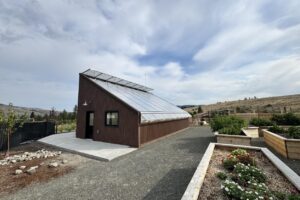
At 5th World, this is the lens we bring to every property we design. Autonomous systems. Regenerative cycles. Closed loops. Not because it is idealistic—but because it is the only design philosophy that actually works long-term. The Inuit proved that across millennia.
The knowledge was never lost. We just stopped paying attention to it.
Rob Avis is the Co-founder of 5th World. He has spent 18 years designing food, energy, and water systems for properties and communities that want to be genuinely self-sufficient.