


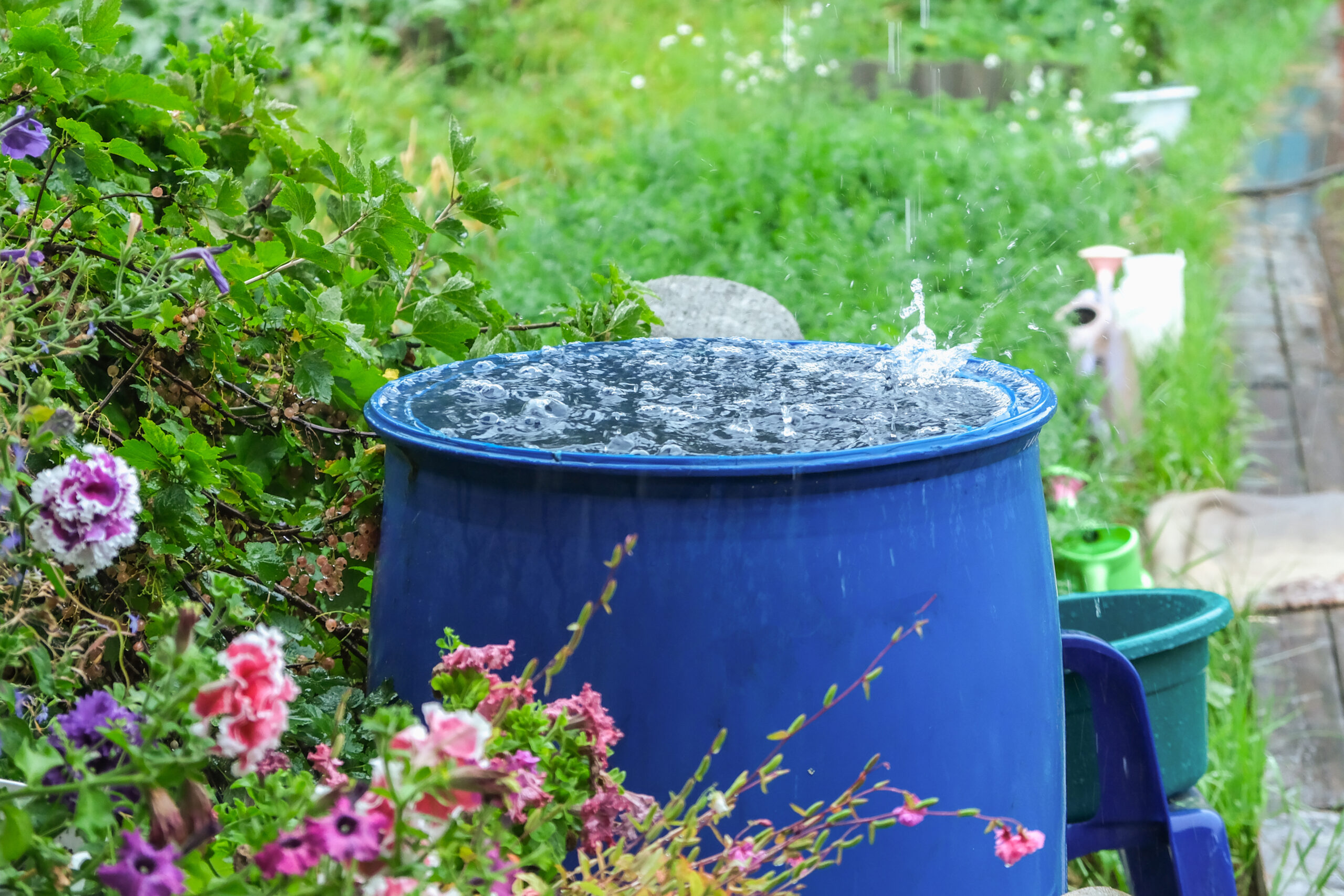
Rain is not a problem to be drained away.
It is an asset to be designed around.
For a regenerative property, rainwater collection and rainwater harvesting are about much more than installing a cistern beside a building. They are about understanding where water comes from, where it moves, where it is stored, where it infiltrates, and how it can support the wider ecological and economic function of a property.
That shift in perspective matters.
A conventional property often treats rain as something that needs to move quickly off roofs, driveways, and compacted surfaces. A regenerative property asks a different question:
How can we keep more of that water on the land, for longer, and put it to productive use?
Done well, rainwater harvesting can reduce dependence on municipal or well water, support food production, improve landscape resilience, reduce runoff, and contribute to healthier soils and ecosystems.
But the biggest opportunity comes when rainwater harvesting is treated as part of a whole-property water system, rather than as a standalone infrastructure project.
What Is Rainwater Collection and Rainwater Harvesting?
Rainwater collection is the physical capture of precipitation, typically from a roof or other suitable catchment surface.
Rainwater harvesting is the broader process of collecting, conveying, storing, treating, and using that water.
A typical system might include:
- A roof or other catchment surface
- Gutters and downspouts
- Leaf screens and filtration
- A first-flush or diversion system
- A storage tank or cistern
- Pumps and distribution infrastructure
- Irrigation or other end uses
- An overflow system
- Landscape features that receive and infiltrate excess water
The important distinction is that collection is only the beginning.
If a property captures thousands of litres of rainwater but then releases the excess rapidly into a ditch or storm drain, much of the ecological opportunity has been missed.
Regenerative design looks at the entire water cycle.
Why Rainwater Harvesting Belongs in Regenerative Property Design
Water connects nearly every major system on a property.
It affects:
- Soil fertility
- Plant growth
- Food production
- Wetlands and habitat
- Erosion
- Flooding
- Irrigation requirements
- Well demand
- Infrastructure costs
- Landscape maintenance
- Climate resilience
This is why we don’t see rainwater harvesting as simply a plumbing decision.
It is a land-design decision.
Consider a property with a house, barn, greenhouse, orchard, gardens, driveway, forest, and sloping terrain.
A conventional approach might design drainage independently for each building.
A regenerative approach asks how all those elements can work together.
Water falling on a barn could supply a cistern.
That cistern could irrigate an orchard.
Overflow could feed a swale or rain garden.
The swale could slow and infiltrate water upslope of a productive planting area.
Vegetation could improve soil structure and increase infiltration.
Better infiltration could reduce erosion and runoff.
The result is not simply a water-storage system.
It is a water landscape.
How Much Rainwater Can You Collect?

One of the simplest ways to understand the potential of rainwater harvesting is to calculate the approximate volume available from a roof.
A useful planning equation is:
Harvestable water = rainfall × catchment area × runoff coefficient
For example, suppose a building has:
- 200 m² of effective roof area
- 25 mm of rainfall
- A runoff coefficient of 0.8
The theoretical rainfall volume is:
200 m² × 0.025 m = 5,000 litres
After allowing for collection and system losses:
5,000 L × 0.8 = approximately 4,000 litres
That means a single 25 mm rainfall event could potentially provide around 4,000 litres of usable water from this roof.
The actual amount will depend on roof material, system design, losses, rainfall intensity, storage capacity, and how the system handles overflow.
The important lesson is that relatively ordinary rainfall events can represent substantial quantities of water when collected across large roof areas.
Think in Annual Volumes—and Seasonal Patterns
Annual rainfall is useful, but it is not enough.
For property design, when the rain falls can matter more than how much falls over an entire year.
A region might receive substantial annual precipitation while still experiencing a long summer dry period.
This is particularly important in parts of British Columbia and the Pacific Northwest, where seasonal rainfall patterns can create a mismatch between water availability and agricultural demand.
The design question therefore becomes:
How much water can we capture during wet periods and make available when the landscape actually needs it?
That is a storage question, but it is also a landscape-design question.
The Best Rainwater Harvesting System Starts With the Land
One of the most common mistakes is deciding on a tank before understanding the site.
A 5,000-litre tank might be appropriate for one property and completely inadequate—or unnecessarily large—for another.
Before specifying infrastructure, we want to understand:
1. Topography
Where does water naturally flow?
A contour map can reveal opportunities that are invisible when looking only at buildings.
Small changes in elevation can determine whether water:
- Runs toward a road
- Pools beside a building
- Moves into a forest
- Can be diverted toward an orchard
- Can infiltrate into a swale
- Needs to be safely conveyed away
2. Soil
Water behaves differently in sandy, silty, clay-heavy, rocky, compacted, and biologically active soils.
Healthy soil with good structure can function as a form of water infrastructure.
Organic matter, roots, fungal networks, soil aggregates, and pore spaces all influence how water infiltrates and is retained.
This means that soil regeneration can be part of water management.
3. Slope
A sloping site creates both risks and opportunities.
Water moving rapidly downhill can cause erosion and transport sediment.
But carefully designed contours can slow that movement.
Instead of allowing rainfall to become runoff, the landscape can be designed to turn some of that runoff into infiltration.
4. Vegetation
Trees and perennial plants are not merely decorative elements in a rainwater system.
They can intercept rainfall, improve soil structure, provide shade, transpire water, and contribute organic matter.
Planting design should therefore be considered alongside water infrastructure.
5. Existing Infrastructure
Buildings, roofs, roads, drainage ditches, culverts, wells, septic systems, ponds, and property boundaries all influence what is possible.
A good rainwater harvesting plan considers these systems together.
Rainwater Harvesting Is More Than a Cistern
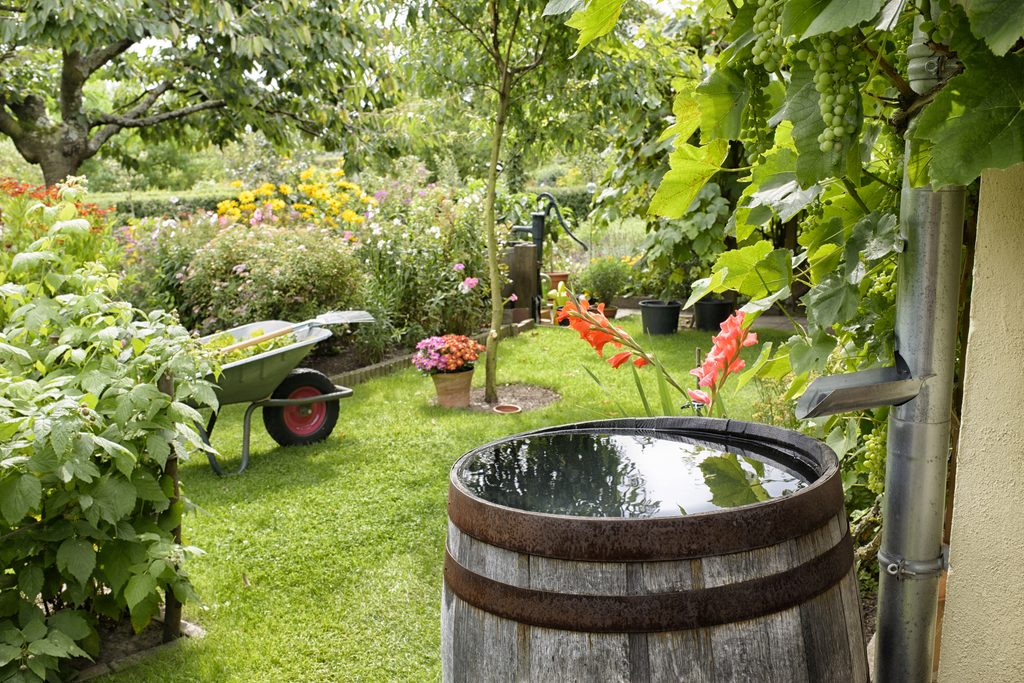
A cistern is useful—but it is only one component.
A regenerative property may combine several forms of water infrastructure.
Roof Catchment
Buildings can provide some of the most predictable water catchment surfaces on a property.
Large roofs—such as barns, workshops, greenhouses, and agricultural buildings—can be especially valuable.
Instead of treating their downspouts as endpoints, they can become starting points for a broader water system.
Cisterns and Tanks
Storage allows water captured during wet periods to be used later.
Tank sizing should be based on actual demand, available catchment, seasonal rainfall, desired reliability, available space, and budget.
The largest possible tank is not automatically the best solution.
Rain Gardens
Rain gardens are shallow planted areas designed to receive and infiltrate stormwater.
They can be particularly useful for managing runoff close to buildings and other impervious surfaces.
Swales and Contour-Based Earthworks
On appropriate sites, contour-based earthworks can slow the movement of water across a landscape.
Rather than attempting to move water off-site as quickly as possible, these systems can create opportunities for infiltration and biological productivity.
They must, however, be designed appropriately for local soils, slopes, rainfall, geology, and site conditions.
Ponds and Larger Storage Features
Where site conditions and regulations allow, ponds can provide larger-scale water storage and habitat.
But a pond should not be treated as a generic solution. Its hydrology, safety, ecological effects, maintenance requirements, and relationship to the site’s drainage patterns need to be understood first.
Absorbent Landscapes
Sometimes the most effective water infrastructure is living soil.
Trees, perennial vegetation, organic matter, and appropriately designed planting areas can help landscapes absorb and retain rainfall.
Cities such as Vancouver are increasingly using green rainwater infrastructure—including absorbent landscapes, bioretention, bioswales, and infiltration systems—to manage rainfall while generating additional ecological benefits.
The same systems-thinking principle applies at the property scale.
Designing Rainwater Harvesting for Food Production
One of the most compelling applications of rainwater harvesting is agriculture.
A productive landscape has a very different water demand from a conventional ornamental landscape.
Instead of watering large expanses of lawn, harvested water can be directed toward higher-value areas such as:
- Vegetable gardens
- Orchards
- Nurseries
- Greenhouses
- Agroforestry systems
- Berry production
- Perennial crops
- Livestock water systems, where appropriate
The goal is not simply to provide more irrigation.
It is to use water strategically.
For example, a property might capture water from a barn roof, store it in a cistern, and use gravity or a low-energy pumping system to irrigate an orchard.
Meanwhile, surrounding landscape areas could be designed to infiltrate rainfall directly into the soil.
This reduces the amount of stored water needed because not every drop has to be captured in a tank.
That is a key regenerative-design principle:
Don’t solve every water problem with a tank. Solve some of them with landscape design.
Rainwater Harvesting and Climate Resilience
Climate resilience is not simply about preparing for more drought.
Properties may also need to handle more intense rainfall events, shifting seasonal patterns, wildfire-related landscape changes, heat, and periods of water scarcity.
A resilient water system therefore needs both storage and release pathways.
You want somewhere for water to go when there is too much.
You also want somewhere for water to come from when there is too little.
This is why a regenerative water system might include:
Capture → Storage → Infiltration → Productive Use → Overflow → Ecological Function
The system should have multiple pathways rather than a single point of failure.
Rainwater Harvesting in British Columbia

British Columbia offers particularly interesting opportunities for rainwater collection because rainfall patterns vary dramatically across the province.
The design of a rainwater harvesting system therefore needs to respond to the specific climate, topography, soil, building type, and intended use of the property.
For potable applications, the requirements are considerably more complex than simply collecting water in a tank. B.C. guidance points to treatment objectives and standards including CSA B805/ICC 805 for rainwater harvesting systems, while building codes and local bylaws may introduce additional requirements.
The 2024 B.C. Plumbing Code also contains prescriptive provisions for certain non-potable rainwater harvesting systems, including requirements around treatment and protection of potable water systems where the two systems interact.
Local requirements can also be significant.
For example, Vancouver has implemented on-site rainwater management requirements for many new developments, with different pathways depending on site characteristics and project type.
This illustrates an important point for property owners:
Rainwater harvesting should be designed with both the landscape and the regulatory context in mind.
For a specific property, applicable municipal bylaws, building requirements, health requirements, and professional engineering requirements should be confirmed before construction.
The Economics of Rainwater Collection
It is tempting to evaluate rainwater harvesting purely by asking:
“How long until the tank pays for itself?”
That can be useful—but it is an incomplete question.
A regenerative property should be evaluated based on the broader value created by the water system.
Potential benefits can include:
- Reduced potable-water demand
- Reduced irrigation costs
- Greater drought resilience
- Lower runoff
- Reduced erosion
- Improved agricultural productivity
- Healthier soils
- Improved habitat
- Reduced dependence on centralized infrastructure
- Greater long-term land functionality
Not every benefit will appear as a line item on a utility bill.
That does not make it economically irrelevant.
A property that can produce more food, retain more water, support healthier soils, and remain productive during periods of water stress may have greater long-term resilience and utility.
This is where regenerative design differs from conventional sustainability.
The objective isn’t simply to reduce harm.
It is to design systems that create multiple forms of value simultaneously.
Common Rainwater Harvesting Mistakes
Mistake 1: Choosing the Tank First
Storage capacity should follow an understanding of supply and demand.
Start with the site, rainfall, catchment, water demand, and seasonal pattern.
Then determine storage requirements.
Mistake 2: Capturing Everything in Tanks
Not every litre needs to be stored.
Some water may be better directed into healthy soils, planted areas, infiltration features, or other landscape systems.
Mistake 3: Ignoring Overflow
Every storage system needs a safe overflow strategy.
A tank that fills during a major storm still has to deal with incoming water.
Overflow should be designed intentionally rather than becoming an accidental drainage problem.
Mistake 4: Treating Water as Separate From Soil
Poor soil can turn a rainfall event into runoff.
Healthy soil can become part of the site’s water-storage system.
Water and soil should therefore be designed together.
Mistake 5: Designing Around Average Rainfall
Average annual rainfall can conceal long dry periods and intense storm events.
Seasonality and rainfall intensity matter.
Mistake 6: Forgetting Maintenance
Filters need cleaning.
Tanks need inspection.
Pumps need maintenance.
Sediment needs management.
Vegetation needs to be maintained.
A resilient system is one that people can realistically operate for decades.
A Better Process for Designing Rainwater Harvesting Systems
At 5th World, we believe the strongest property designs begin with understanding the whole system before choosing individual interventions.
A practical process might look like this:
Step 1: Map the Property
Understand topography, buildings, roads, vegetation, drainage, soils, water sources, and existing infrastructure.
Step 2: Understand the Water Budget
Estimate rainfall supply, roof catchment, irrigation demand, domestic or agricultural requirements, and seasonal variation.
Step 3: Identify Water Movement
Determine where water currently accumulates, infiltrates, erodes, or leaves the site.
Step 4: Prioritize Passive Systems
Before adding mechanical infrastructure, look for opportunities to use slope, soil, vegetation, contours, and gravity.
Step 5: Add Storage Where It Creates Value
Use tanks, cisterns, ponds, or other storage where they meaningfully improve resilience or productivity.
Step 6: Connect Water to Productive Landscapes
Consider orchards, food gardens, agroforestry, ecological restoration, livestock systems, and other land uses.
Step 7: Design for Extremes
Plan for both drought and intense rainfall.
Step 8: Build in Maintenance
Every component should have a clear operational purpose and maintenance strategy.
The result is a water system that works with the property rather than against it.
The Bigger Opportunity: Designing the Property as a Living System
Rainwater harvesting is sometimes presented as an isolated sustainability upgrade.
We see it differently.
Water is one of the threads that can connect an entire property.
A roof becomes a catchment.
A cistern becomes storage.
A swale becomes infiltration infrastructure.
Soil becomes a reservoir.
Trees become water-management infrastructure.
An orchard becomes productive water use.
A pond becomes storage and habitat.
And the property begins to function less like a collection of independent components and more like an integrated system.
That is the opportunity of regenerative property design.
Instead of asking:
“How do we get rid of this rainwater?”
we ask:
“How can this property use rainfall to become more productive, resilient, and ecologically healthy?”
That is a much more interesting design problem.
Frequently Asked Questions About Rainwater Collection and Rainwater Harvesting
Is rainwater collection worth it?
It can be, particularly when a property has significant roof area, meaningful irrigation demand, seasonal water constraints, or a broader goal of increasing resilience.
The economics depend heavily on the site’s rainfall, water demand, infrastructure costs, storage requirements, and intended uses.
What is the difference between rainwater collection and rainwater harvesting?
Rainwater collection generally refers to capturing rainwater.
Rainwater harvesting describes the broader system of collecting, conveying, storing, treating, and using that water.
Can rainwater harvesting provide drinking water?
Potentially, but potable rainwater systems require appropriate treatment, system design, monitoring, and regulatory compliance. Requirements vary by jurisdiction and application. In British Columbia, potable applications should be designed with the applicable provincial guidance, standards, building requirements, and local regulations in mind.
How much rainwater can a roof collect?
A useful preliminary calculation is:
Rainfall (mm) × roof area (m²) = litres of rainfall
For example, 25 mm of rain falling on 200 m² of roof represents approximately 5,000 litres before accounting for collection losses.
Is rainwater harvesting useful in areas with lots of rainfall?
Absolutely.
High rainfall does not necessarily mean water is available when you need it.
Rainwater harvesting can help shift water availability across seasons and reduce runoff during wet periods.
Should I use a cistern or a pond?
It depends on the property.
Cisterns provide controlled storage and can be well suited to irrigation or non-potable building uses. Ponds can provide larger storage and ecological functions but require substantially different site, hydrological, safety, and regulatory considerations.
Often, the best solution is not one or the other but a combination of storage, infiltration, and landscape-based water management.
Can rainwater harvesting improve soil?
Indirectly, yes.
When rainwater is intentionally infiltrated and landscapes are designed to build soil organic matter and structure, the property can retain more water within the soil profile.
Water management and soil regeneration can therefore reinforce each other.
Ready to Design a More Resilient Property?

The best rainwater harvesting system isn’t necessarily the biggest tank or the most sophisticated technology.
It is the system that fits the land.
At 5th World, we approach water as part of a larger regenerative-property system—one that considers topography, soils, ecology, food production, buildings, infrastructure, and long-term land value together.
If you’re developing a rural property, farm, homestead, retreat, agricultural project, or other land-based development, we can help you understand how water can become one of the property’s greatest assets.
Book a Free Introductory Call to discuss your project and explore what’s possible.
Want to start with your land? Use our Free Contour Map Generator to begin understanding how topography can shape water movement, access, planting, and property design.