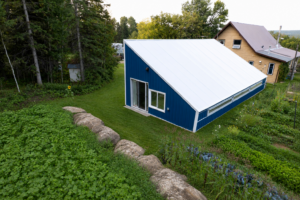


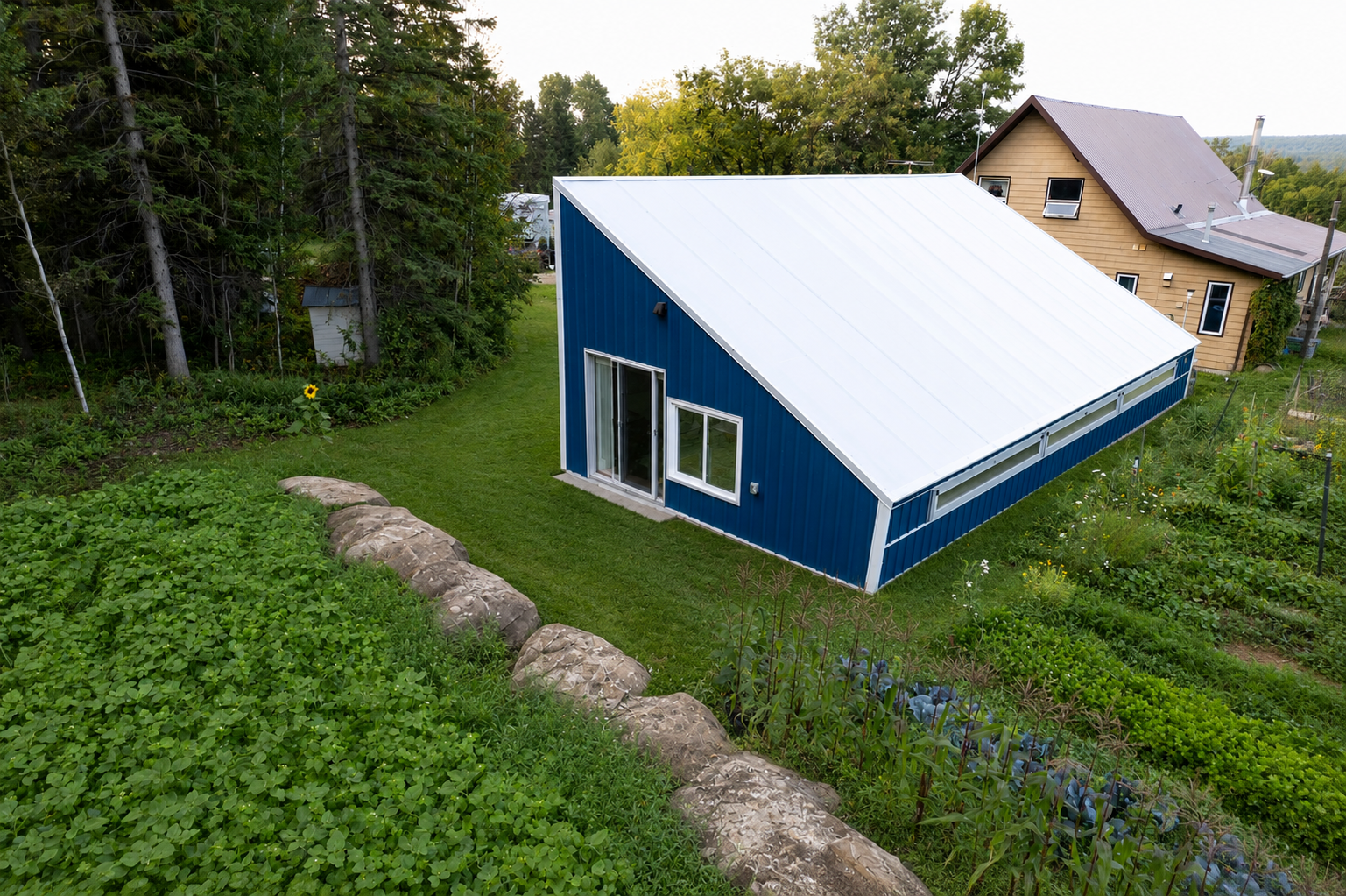
A greenhouse is often treated as a simple agricultural structure: Capture sunlight, grow plants, add heaters when temperatures drop.
But that approach misses a much bigger opportunity.
A passive solar greenhouse can be designed as an integrated environmental system—one that captures solar energy, stores heat, manages water, produces food, and potentially becomes part of the way people live on a property.
This is the difference between adding a greenhouse to a property and designing the greenhouse into the property.
For landowners in cold climates such as British Columbia, Alberta, or other northern regions, thoughtful greenhouse passive heating can extend the growing season while reducing dependence on conventional heating. And when food production, architecture, water, energy, and human habitation are considered together, the greenhouse can become an important component of regenerative greenhouse living.
What Is a Passive Solar Greenhouse?
A passive solar greenhouse is designed to use the sun and the building itself to collect, store, distribute, and conserve heat rather than relying primarily on mechanical heating.
The basic principle is simple.
Capture heat when the sun is available, store it, reduce heat loss, and release that stored energy when temperatures fall.
The engineering is more complex.
A high-performance passive solar greenhouse typically considers:
- Solar orientation
- Glazing and solar aperture
- Insulation
- Thermal mass
- Air movement and heat distribution
- Ventilation
- Climate and microclimate
- Water availability
- Growing requirements
- Seasonal solar angles
- Building use and occupancy
This is why passive solar greenhouse design should begin with the site—not with a standard greenhouse kit.
5th World’s passive solar greenhouse, for example, uses a systems approach that combines orientation, thermal mass, insulation, and other design strategies to dramatically reduce energy use compared with traditional greenhouse models.
The goal isn’t simply to make a greenhouse warmer.
The goal is to make the entire system work more intelligently.
How Greenhouse Passive Heating Actually Works
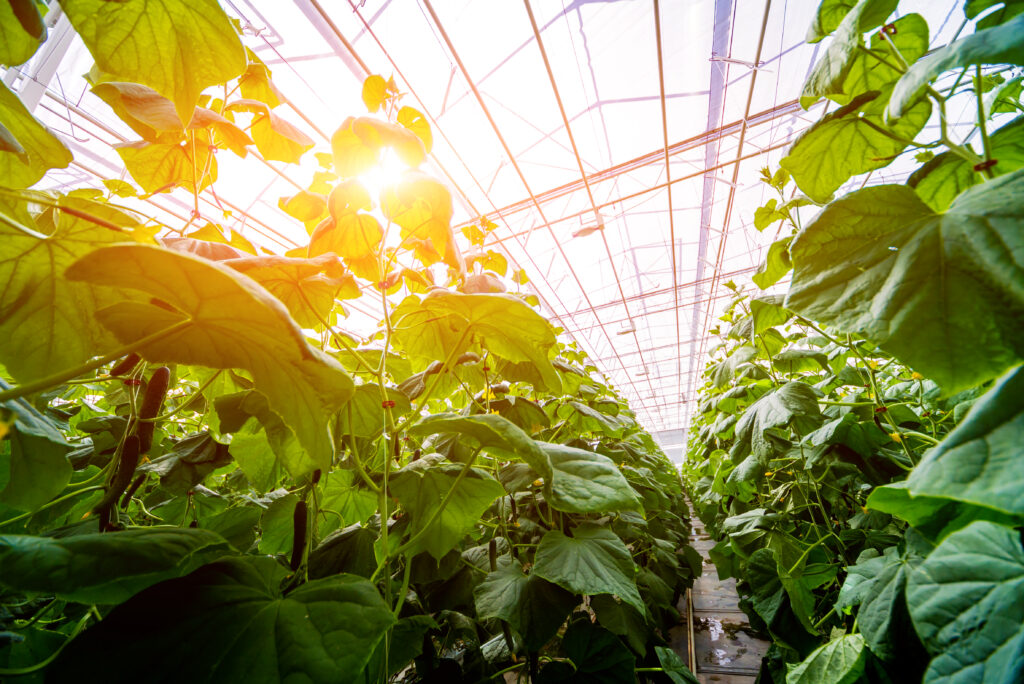
The most important concept in greenhouse passive heating is that solar gain is only half the equation.
You also need somewhere for that energy to go.
1. Capture solar energy
In northern climates, orientation is critical.
A greenhouse can be positioned and shaped to maximize useful solar exposure during the parts of the year when heating is most valuable. The angle and amount of glazing influence how much sunlight enters the structure.
But more glass isn’t automatically better.
Large glazed surfaces can create substantial heat gains during sunny periods while also increasing heat loss when outdoor temperatures fall.
Good design balances both.
2. Store the heat
Thermal mass acts as a battery.
Materials such as water, soil, concrete, stone, or other dense materials can absorb heat during the day and release it later.
This creates a time delay between when solar energy enters the greenhouse and when that energy is needed.
That delay is extremely valuable.
Instead of allowing a warm greenhouse to become cold as soon as the sun disappears, thermal mass can moderate temperature swings and reduce the amount of supplemental energy required.
This principle is central to the climate-battery approach used in 5th World’s passive solar greenhouse designs.
3. Reduce heat loss
Passive heating doesn’t work well if the captured energy immediately escapes.
Insulation, air sealing, glazing selection, thermal bridges, and the ratio between transparent and insulated surfaces all matter.
In cold climates, the greenhouse envelope must be designed around the actual winter conditions of the site.
A greenhouse in Kamloops, British Columbia, for example, presents a different design challenge than one in southern Ontario or Colorado. 5th World’s passive solar greenhouse research and case studies have examined projects located across North America, such as in Kamloops, Calgary, London, and Boulder.
4. Distribute heat where it matters
Heat doesn’t necessarily need to remain where it was captured.
Air movement, thermal mass, circulation pathways, and building configuration can help distribute energy throughout the system.
This is where systems engineering becomes more important than simply selecting a greenhouse material.
A successful design asks:
Where does the heat go at noon? Where does it go at midnight? And where does it need to be six hours from now?
That is a very different question from, “What kind of greenhouse should I buy?”
Why a Passive Solar Greenhouse Is More Than Food Production
The conventional model treats the greenhouse as a standalone structure.
A regenerative property treats it as infrastructure.
A greenhouse can potentially interact with:
- Rainwater harvesting
- Irrigation systems
- Water storage
- Solar energy
- Food forests
- Composting
- Soil-building systems
- Kitchens and food-processing spaces
- Root cellars and storage
- Livestock systems
- Residential spaces
- Outdoor living areas
This creates opportunities for multiple systems to perform multiple functions.
For example, water storage can support irrigation while also contributing to thermal mass. A greenhouse can produce food while providing a buffer space between outdoor and indoor environments. A carefully designed structure can support food production, processing, storage, recreation, and wellness.
This is the beginning of greenhouse living.
Greenhouse Living: From Growing Space to Lifestyle Infrastructure
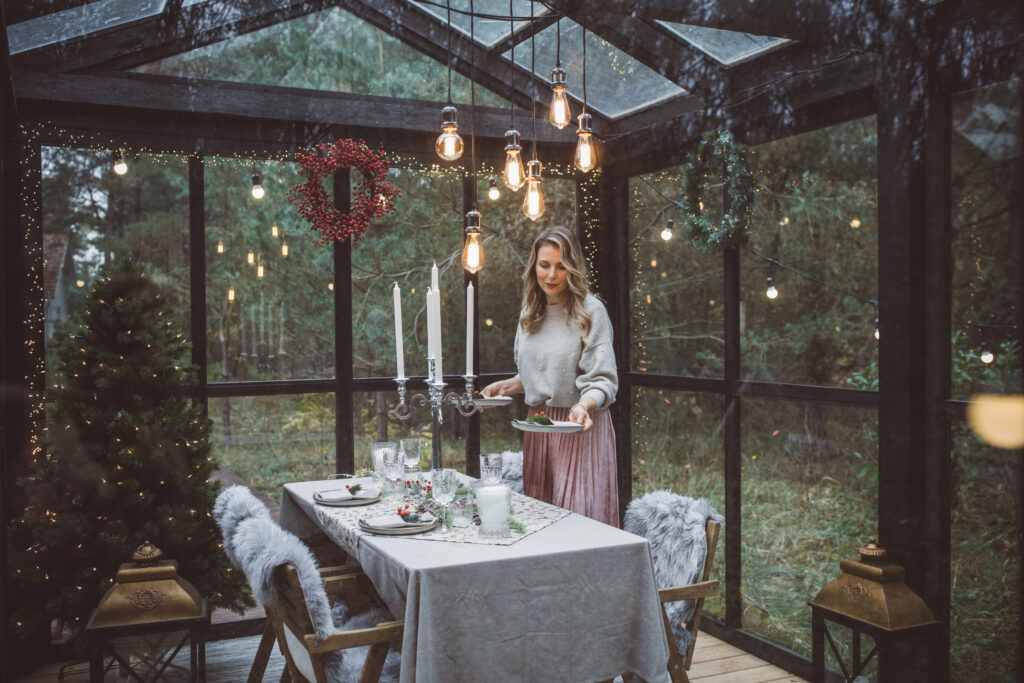
Greenhouse living doesn’t necessarily mean turning a greenhouse into a bedroom or permanently living inside a growing structure.
It means reconsidering what a greenhouse can contribute to daily life.
Imagine a structure where you can:
- Harvest fresh food in winter
- Start seedlings earlier in the season
- Spend time surrounded by plants
- Process and preserve food
- Gather with family and friends
- Create a warm microclimate during cold weather
- Connect residential spaces with productive landscapes
5th World has explored this idea through greenhouse concepts that combine food production with lifestyle, wellness, and recreational spaces.
That changes the economic question.
Instead of asking only, “How much food will this greenhouse produce?”
A landowner can ask:
“How many functions can this structure perform?”
That is a regenerative design question.
Designing a Passive Solar Greenhouse as Part of the Property
The biggest mistake is designing the greenhouse in isolation.
Before determining the building footprint, a regenerative property design process should consider the entire landscape.
Start with the land.
Topography, solar exposure, prevailing winds, water movement, soil, existing vegetation, access, and microclimates all influence greenhouse performance.
This is why site analysis should precede construction.
A contour map, for example, can reveal elevation patterns and water movement that influence where infrastructure should be placed. 5th World recently upgraded its free Contour Map Generator to provide more detailed elevation data across Canada and the United States, supporting decisions around water movement, erosion, planting zones, earthworks, and overall site design.
Evaluate your land with 5th World’s free Contour Map Generator.
Then connect water, energy, and food.
A greenhouse becomes significantly more valuable when it is connected to other systems.
Consider a property where:
Rainwater → storage → irrigation → greenhouse → food production → kitchen → compost → soil → food production
Now the greenhouse isn’t a standalone building.
It’s one component in a circular system.
In one 5th World greenhouse project, watershed infrastructure—including swales, ponds, and a one-million-gallon reservoir—was integrated with greenhouse irrigation, creating a gravity-fed water supply independent of a weak well.
The lesson is important: Greenhouse performance depends on the systems around the greenhouse.
Passive Solar Greenhouse Design Should Be Climate-Specific

There is no universally optimal passive solar greenhouse.
A design that works in British Columbia may require substantial modification for Alberta. A greenhouse intended for tropical crops has different requirements from one optimized for cold-hardy vegetables.
Climate determines the problem you are trying to solve.
In a cold northern climate, priorities may include:
- Maximizing winter solar gain
- Minimizing nighttime heat loss
- Increasing thermal storage
- Protecting against cold winds
- Managing snow loads
- Controlling condensation
- Maintaining adequate winter light
In warmer climates, overheating and ventilation can become equally important.
The best design therefore starts with climate data and site conditions rather than a predetermined building template.
The Economic Case for Greenhouse Passive Heating
Energy efficiency is not simply an environmental benefit.
It can be an economic strategy.
5th World’s passive solar greenhouse white paper notes that heating can represent up to 35% of production costs in Canadian greenhouses, illustrating why reducing heating demand can have meaningful financial implications.
But the financial analysis shouldn’t stop at energy savings.
A regenerative property should be evaluated across its total system.
Potential value can come from:
- Lower energy requirements
- Extended growing seasons
- Increased food production
- Greater resilience during outages
- Reduced dependence on external inputs
- Improved property functionality
- Greater lifestyle value
- Long-term land productivity
This is consistent with a broader regenerative property philosophy: Design systems that reduce vulnerability while increasing the productive and ecological capacity of the land.
A Better Way to Think About Greenhouses

The future of greenhouse design isn’t necessarily about building bigger structures with more technology.
It may be about building smarter systems.
A passive solar greenhouse can become a thermal system, food system, water system, architectural system, and lifestyle system at the same time.
That requires a shift from component thinking to systems thinking.
Instead of asking:
What greenhouse should I build?
Ask:
What should this greenhouse do for the entire property?
That question can lead to very different design decisions.
It can change where the greenhouse is located, how it is oriented, how water reaches it, how heat moves through it, what crops are grown, what spaces surround it, and how people use it.
For landowners considering a regenerative property in British Columbia, Alberta, or elsewhere in North America, the greenhouse may be one of the highest-leverage pieces of infrastructure on the site—but only if it is designed as part of the larger system.
Passive Solar Greenhouse FAQ
How does a passive solar greenhouse stay warm in winter?
It captures solar energy through appropriately oriented glazing, stores heat in thermal mass, minimizes heat loss through insulation and building-envelope design, and distributes stored energy as temperatures fall. The exact strategy depends on climate, site conditions, greenhouse geometry, and crop requirements.
What is greenhouse passive heating?
Greenhouse passive heating is the use of naturally available solar energy and building-design strategies to reduce the need for mechanical heating. It commonly involves solar orientation, thermal mass, insulation, air movement, and heat-loss reduction.
Can a passive solar greenhouse work in Canada?
Yes. Passive solar greenhouse systems can be designed for Canadian climates, but the design must respond to local solar exposure, winter temperatures, snow, wind, glazing, insulation, and crop requirements. 5th World has developed and studied passive solar greenhouse projects in several Canadian locations, including Kamloops, British Columbia, and Calgary, Alberta.
Can a greenhouse become part of a home?
A greenhouse can be designed as an extension of residential life, depending on the intended use, building code, climate, and design. Modern greenhouse concepts increasingly combine food production with wellness, recreation, and other living functions.
Is a passive solar greenhouse worth the investment?
The answer depends on the property and intended use. A proper evaluation should consider not only construction cost and energy savings, but also food production, resilience, water systems, lifestyle benefits, and long-term property value.
Design the Greenhouse Into the Property

A greenhouse should not be an afterthought placed wherever there is room.
When designed correctly, it can become part of a larger regenerative system—capturing energy, storing heat, managing water, producing food, supporting human well-being, and increasing the usefulness of the property.
That is the real opportunity behind passive solar greenhouse design.
At 5th World, we approach regenerative properties by integrating food, water, energy, ecology, architecture, and human needs into one connected system. Our work spans property analysis, concept design, detailed design and implementation, regenerative agriculture, and circular infrastructure.
Explore the 5th World Passive Solar Greenhouse Case Study to see how these principles have been applied in practice.
You can also explore The Most Advanced Greenhouse in the World or learn more about regenerative property design.
Ready to explore what’s possible on your property?
Book a Free Introductory Call.
Talk with the 5th World team about your land, your goals, and how a regenerative property system could integrate food, water, energy, and greenhouse living.